Location-based Mobile Interventions for Alcohol Consumption in Mexican Youth: Perceived Usefulness and Ease of Use
DOI:
https://doi.org/10.17488/RMIB.47.SI-TAIH.1560Keywords:
Human Computer Interaction, Mexican youth drinking, Mobile alcohol interventionsAbstract
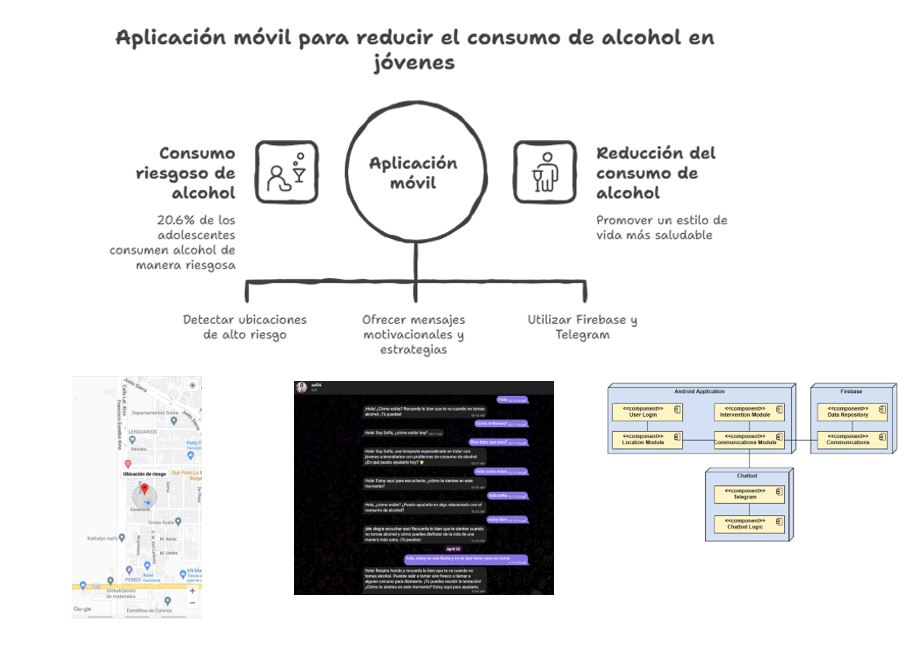
In Mexico, addressing risky alcohol consumption and binge drinking among youth represents a critical public health challenge, with significant implications for both physical and mental health. This study explores the potential of mobile interventions, particularly location-based interventions and conversational agents, to mitigate alcohol misuse among Mexican youth, with the potential to integrate these technologies into existing healthcare systems. We conducted a comprehensive review of the literature on mHealth interventions and geofencing technologies, with a focus on their clinical relevance and applicability. Leveraging emerging technologies, we developed a mobile platform for location-based interventions that monitors and provides feedback on alcohol consumption patterns. We recruited 38 participants (10 women, 28 men) to evaluate the platform’s perceived ease of use and usefulness using the Technology Acceptance Model (TAM). Overall, perceived usefulness (PU) and perceived ease of use (PEoU) scores were positive. While women rated the platform slightly higher, only two items revealed significant gender differences across all items. Our findings highlight the promising role of mobile interventions in augmenting traditional clinical strategies, offering personalized support to young individuals at risk of developing alcohol use disorders. Furthermore, we discuss the potential applications of these technologies in addressing other psychological disorders, underscoring their versatility in mental health care. This study contributes to the growing body of evidence supporting the integration of technology into public health initiatives, particularly in emerging economies like Mexico.
Downloads
References
World Health Organization. (2019). Global status report on alcohol and health 2018. World Health Organization.
Ramírez-Toscano, Y., Canto-Osorio, F., Carnalla, M., Colchero, M. A., Reynales-Shigematsu, L. M., Barrientos-Gutiérrez, T., & López-Olmedo, N. (2023). Patrones de consumo de alcohol en adolescentes y adultos mexicanos: Ensanut Continua 2022. Salud Pública de México, 65, s75-s83.
American Psychiatric Association. (2022). Diagnostic and Statistical Manual of Mental Disorders (5th ed., text rev.). https://doi.org/10.1176/appi.books.9780890425787.
Gómez, R. M., Icaza, M. E. M. M., Velázquez, J. A. V., Gamiño, M. B., Sainz, T., & Gómez-Maqueo, E. L. (2022). Problematic alcohol use in Mexican students: Transmission from parents to children. Salud mental, 45(1), 19-28.
White, A. M. (2020). Gender differences in the epidemiology of alcohol use and related harms in the United States. Alcohol research: current reviews, 40(2).
Wilsnack, R. W., Wilsnack, S. C., Gmel, G., & Kantor, L. W. (2018). Gender differences in binge drinking: Prevalence, predictors, and consequences. Alcohol research: current reviews, 39(1), 57.
Terry‐McElrath, Y. M., Arterberry, B. J., & Patrick, M. E. (2023). Alcohol use contexts (social settings, drinking games/specials, and locations) as predictors of high‐intensity drinking on a given day among US young adults. Alcohol: Clinical and Experimental Research, 47(2), 273-284.
Finan, L. J., & Lipperman‐Kreda, S. (2020). Changes in drinking contexts over the night course: Concurrent and lagged associations with adolescents’ nightly alcohol use. Alcoholism: Clinical and Experimental Research, 44(12), 2611-2617.
Arcury, T. A., Furgurson, K. F., O'Hara, H. M., Miles, K., Chen, H., & Laurienti, P. J. (2019). Conventional and Complementary Therapy Use among Mexican Farmworkers in North Carolina: Applying the I-CAM-Q. Journal of agromedicine, 24(3), 257–267. https://doi.org/10.1080/1059924X.2019.1592049
Marsiglia, F. F., Kulis, S., Rodriguez, G. M., Becerra, D., & Castillo, J. (2009). Culturally Specific Youth Substance Abuse Resistance Skills: Applicability across the U.S.-Mexico Border. Research on social work practice, 19(2), 152–164. https://doi.org/10.1177/1049731507303886
Marsiglia, F. F., Medina-Mora, M. E., Gonzalvez, A., Alderson, G., Harthun, M., Ayers, S., Gutiérrez, B. N., Corona, M. D., Melendez, M. A. M., & Kulis, S. (2019). Binational Cultural Adaptation of the keepin' it REAL Substance Use Prevention Program for Adolescents in Mexico. Prevention science: the official journal of the Society for Prevention Research, 20(7), 1125–1135. https://doi.org/10.1007/s11121-019-01034-0
Domhardt, M., Messner, E. M., Eder, A. S., Engler, S., Sander, L. B., Baumeister, H., & Terhorst, Y. (2021). Mobile-based interventions for common mental disorders in youth: a systematic evaluation of pediatric health apps. Child and Adolescent Psychiatry and Mental Health, 15(1), 1-12.
Berman, A. H., Molander, O., Tahir, M., Törnblom, P., Gajecki, M., Sinadinovic, K., & Andersson, C. (2020). Reducing Risky Alcohol Use via Smartphone App Skills Training Among Adult Internet Help-Seekers: A Randomized Pilot Trial. Frontiers in psychiatry, 11, 434. https://doi.org/10.3389/fpsyt.2020.00434
Crane, D., Garnett, C., Michie, S., West, R., & Brown, J. (2018). A smartphone app to reduce excessive alcohol consumption: Identifying the effectiveness of intervention components in a factorial randomised control trial. Scientific reports, 8(1), 1-11.
Garnett, C., Crane, D., West, R., Brown, J., & Michie, S. The development of Drink Less: an alcohol reduction smartphone app for excessive drinkers. Transl Behav Med. 2019 Mar 1; 9 (2): 296–307. https://doi.org/10.1093/tbm/iby043
Gustafson Sr, D. H., Gustafson Jr, D. H., Mares, M. L., Johnston, D. C., Vjorn, O. J., Curtin, J. J., ... & Bailey, G. L. (2024). Couple-Focused Smartphone Intervention to Reduce Problem Drinking: Pilot Randomized Control Trial. JMIR formative research, 8(1), e58622.
Lauckner, C., Takenaka, B. P., Sesenu, F., Brown, J. S., Kirklewski, S. J., Nicholson, E., ... & Kershaw, T. (2024). Combined Motivational Interviewing and Ecological Momentary Intervention to Reduce Hazardous Alcohol Use Among Sexual Minority Cisgender Men and Transgender Individuals: Protocol for a Randomized Controlled Trial. JMIR Research Protocols, 13(1), e55166.
Aggarwal, A., Tam, C. C., Wu, D., Li, X., & Qiao, S. (2023). Artificial Intelligence–Based Chatbots for Promoting Health Behavioral Changes: Systematic Review. Journal of Medical Internet Research, 25, e40789.
Prochaska, J. J., Vogel, E. A., Chieng, A., Kendra, M., Baiocchi, M., Pajarito, S., & Robinson, A. (2021). A therapeutic relational agent for reducing problematic substance use (Woebot): development and usability study. Journal of medical Internet research, 23(3), e24850.
Omarov, B., Zhumanov, Z., Gumar, A., & Kuntunova, L. (2023). Artificial intelligence enabled mobile chatbot psychologist using AIML and cognitive behavioral therapy. International Journal of Advanced Computer Science and Applications, 14(6).
Rasmus, S. M., Whitesell, N. R., Mousseau, A., & Allen, J. (2020). An intervention science to advance underrepresented perspectives and indigenous self-determination in health. Prevention Science, 21(Suppl 1), 83-92.
Lozada-Tequeanes, A. L., Théodore, F. L., Kim-Herrera, E., García-Guerra, A., Quezada-Sánchez, A. D., Alvarado-Casas, R., & Bonvecchio, A. (2024). Effectiveness and Implementation of a Text Messaging mHealth Intervention to Prevent Childhood Obesity in Mexico in the COVID-19 Context: Mixed Methods Study. JMIR mHealth and uHealth, 12(1), e55509.
Davis, F. D. (1989). Perceived Usefulness, Perceived Ease of Use, and User Acceptance of Information Technology. MIS Quarterly, 13(3), 319–340. https://doi.org/10.2307/249008
Edwards, E. S., & Sackett, S. C. (2016). Psychosocial variables related to why women are less active than men and related health implications: supplementary issue: health disparities in women. Clinical Medicine Insights: Women's Health, 9, CMWH-S34668.
Rosenfield, S., & Mouzon, D. (2013). Gender and mental health. Handbook of the sociology of mental health, 277-296.
Skeen, S. J., Tokarz, S., Gasik, R. E., Solano, C. M., Smith, E. A., Sagoe, M. B., ... & Clum, G. A. (2023). A trauma-informed, geospatially aware, just-in-time adaptive mHealth intervention to support effective coping skills among people living with HIV in New Orleans: development and protocol for a pilot randomized controlled trial. JMIR Research Protocols, 12(1), e47151.
Aydın, F. (2025). Examining Gender Differences in Social Media Language. Bulletin of Language and Literature Studies, 2(1).
Published
How to Cite
Issue
Section
License
Copyright (c) 2026 Revista Mexicana de Ingenieria Biomedica

This work is licensed under a Creative Commons Attribution-NonCommercial 4.0 International License.
Upon acceptance of an article in the RMIB, corresponding authors will be asked to fulfill and sign the copyright and the journal publishing agreement, which will allow the RMIB authorization to publish this document in any media without limitations and without any cost. Authors may reuse parts of the paper in other documents and reproduce part or all of it for their personal use as long as a bibliographic reference is made to the RMIB. However written permission of the Publisher is required for resale or distribution outside the corresponding author institution and for all other derivative works, including compilations and translations.